Saturday, June 02, 2007

Cakes: Celebrating my birthday month

How do people find time to up-date their blogs on a regular basis? Between working, getting ready for a new job, preparing to move over the hill, and taking a trip to Minnesota this past week, the time just seems to slip through my fingers.

Till I can get on track with cooking (I haven't gone grocery shopping since I got back into town in the wee hours of Friday morning, and the cupboards are bare), I present to you a pineapple upside-down cake, which I baked in honor of my cat turning three on May 16. (The cake, obviously, was for the humans in the household. Sabriel got some of his favorite canned tuna.)

While making this cake, I learned an important lesson: Don't make upside-down cakes in a springform pan. The recipe called for a 2-inch deep cake pan, and since mine was only 1-1/2 inches deep, I thought the springform pan would be the next best thing, being that it was made extra deep to hold delicious mile-high cheesecake goodness. Well, when the sound of splattering on the bottom of the oven got my attention, I realized all the lovely brown sugar and butter that the pineapple was supposed to cook in was slowly making its escape. The resulting cake was fine, though it lacked a sugary glaze and, therefore, some sweetness.

Stay tuned for more of my favorite cake recipes as we count down the days till my Cancerian birthday.


Fresh pineapple upside-down cake
(courtesy of Gourmet magazine)

1-2/3 c all-purpose flour
1-1/2 tsp baking powder
1/4 tsp baking soda
1/4 tsp salt
1/2 fresh pineapple, halved lengthwise, cored, and peeled
1-1/2 sticks (3/4 cup) unsalted butter, softened
1/2 c packed light brown sugar
2/3 c granulated sugar
1 teaspoon pure vanilla extract
2 large eggs
2/3 cup well-shaken buttermilk (I did the "cheating" method of mixing 1 tablespoon of white vinegar into 1 c milk and letting it sit for 5 min)

Preheat oven to 350°F.

Mix together flour, baking powder and soda, and salt into a bowl. Cut pineapple crosswise into 1/4-inch-thick wedges.

Butter a 9-inch round cake pan (2 inches deep) lightly on side and generously on bottom of pan using 1/2 stick butter. Sprinkle all of brown sugar evenly over bottom and arrange pineapple over it, starting in center of pan and overlapping slices slightly.

Beat together remaining stick butter, granulated sugar, and vanilla with an electric mixer at medium speed, about 2 min, then add eggs 1 at a time, beating well after each addition. Mix in flour mixture alternately with buttermilk in batches, beginning and ending with flour and mixing just until batter is smooth.

Spread batter evenly over pineapple and bake until a wooden pick inserted in center of cake comes out clean, 40 to 45 min. Cool 15 min in pan on a rack, then invert cake onto a plate and remove pan. Cool to room temperature.

Serves 8 to 10.

Monday, May 14, 2007

Food for thought

The Anthropologist took the qualifying exams for his Ph.D. last week. The week before that, he mentioned that it was traditional for the student to provide his committee of professors with something to nibble on during the exams. Wanting to help -- and also wanting an opportunity to show off my cooking skills -- I told him not to worry about the food, that I'd take care of it.

The Anthropologist's committee chair had recommended finger foods, like veggies and fruit. I think she didn't want the Anthropologist to have something else to have to worry about. Little did she know, that he has a girlfriend who makes even the most simple foods fancy. I did include fruit and veggies -- I just gussied them up a bit.

I decided on a simple but filling menu: pesto chicken salad on rosemary focaccia with roasted red peppers, blue cheese-stuffed endive, and tropical fruit salad with ginger syrup.

The fruit salad came about because I saw that fresh pineapples were on sale. I never get to buy a fresh pineapple because, well, I'm allergic. (It's too highly acidic, so I can only eat one or two pieces.) I got so much joy out of cutting it up: it smelled so fragrant and tasted so sweet. I think preparing the pineapple was the highlight of this entire cooking endeavor.

I was a little nervous about how the food would be received. I've never met any of the people who would be eating it, so I didn't know what everyone's tastes in food were. But the containers I had sent off with the Anthropologist came back empty, which is exactly what a cook wants to see!

Incidentally, the Anthropologist passed his exams. Not thanks to my food, of course, but I think I at least put his committee in a good mood with a tasty meal.

Saturday, May 12, 2007

Breakfast discovery

Lately, on most mornings when I'm not running out the door late, I eat a bowl of hot cereal. I have it down to an exact science: 1/3 cup of Bob's Old Mill organic 10-grain cereal, 1 tablespoon of flax seed (which brings it to a total of 12 grams of fiber — this is not for the weak of intestines!), 1/2 cup of water, and 1/4 cup whole milk. The trick is not to stir it at all, just dump everything in. This gets microwaved for two minutes, then sits for a few minutes to cool. I've found that if you stir too early, the cereal becomes thick and clumpy, which is not at all how I like it. Now, add a spoonful of sugar, followed by a healthy dash of cinnamon. (This final addition began when I read an article about the correlation between the consumption of cinnamon and a reduced risk of diabetes.)

Today, as I took the jar of cinnamon down from the cupboard above the sink, I eyed the ground cloves. Ground cloves, I thought. They taste good with cinnamon. So I added a little pinch. You know what tastes good with cinnamon and cloves? Ginger. In it went. The result? Just a hint of spice, like gingerbread.

I love gingerbread. Why hadn't I thought of this before?

I wonder what other spices work well in hot cereal.

Friday, May 11, 2007

Like Christmas

On Wednesday, I received a package in the mail. It was a medium-sized box, but it was heavier than it looked. I was on my way to work, so I brought the box with me to the car. Finally, at a stop light, I opened up the top with my house key. Inside, it was like Christmas: five hardcover cookbooks.

I have a huge collection of cookbooks. This probably comes as no surprise, considering how much I love food and cooking. But when I go to friends' homes or look around the houses I work in, I find that most people have maybe a handful of cookbooks that fit neatly in a small space in the kitchen. In comparison, I have a small, three-shelf bookcase that holds something like 36 books. That's not too many, is it? (And that's not including the few I managed to purge out and am trying to sell on Amazon — plus the ones I just got!)

A few weeks ago, I received an ad for a cookbook book club, which offered four books for fifty cents a pop. Fifty cents! All I had to commit to was a purchase of three more books in the next two years. I decided to take advantage of their "buy your first book now" deal, which came at half the price. So for about $35, or the cost of one hardcover cookbook, I got five. Am I the only one who finds this an incredibly awesome deal?

As for those two other books I'm supposed to buy? I've already ordered one more.

Thursday, May 10, 2007

The wedding banquet

When I heard my cousin was getting married, I immediately began looking forward to the reception. His new wife is Chinese, and so I knew that I'd finally — after drooling over other people's stories of the food at Chinese wedding receptions — get to experience the deliciousness that is a multi-course banquet.

It took a while for the food to actually happen. The invitation said 6PM, and when I got there late at 7:30 (because, man, it takes forever to curl my hair, plus there was zero parking thanks to two receptions that were happening at the restaurant), there was still another hour wait before food was served. It was well worth the wait, though, because it was good. This wasn't your usual Americanized Chinese fare, like the take-out I'm eating at this very moment: chow mein, almond chicken, or sweet and sour pork. I hate when people use the word "authentic" to describe food (and I'm not even going to get into why that is), but this was what I think of when people talk about "authentic" Chinese food.

There was much discussion the day of the wedding about the exact number of courses that were going to be served. I heard the total was anywhere between seven and eleven. Here is the actual total:
• Cold barbecued meats, including char siu, duck, and chicken.
• Deep-fried crab and shrimp balls, with little crab claw "handles."
• Scallops and shrimp with snow peas and candied walnuts.
• Shark fin soup (which I did not eat because most shark fin comes from endangered sources).
• Lobster with a heavy butter sauce. (A very labor-intensive dish because we had to shell the lobster pieces ourselves.)
• Abalone and sea cucumber with shiitake mushrooms. (My brother commented that sea cucumber is like "the Jello of the sea." It does have a very, um, interesting texture, and I can only ever eat one bite when I have it.)
• Steamed fish with green onion.
• A very simple fried rice with bits of shrimp and crab.
• Taro root paste with sweet syrup and dried fruits.

Nine courses! Which left only enough room at the end to have two bites of the bright green wedding cake.

Wednesday, May 09, 2007

The simplicity of pasta

The thing I like best about pasta is that you can dress it up in so many ways. It's even better when it can be done simply, as evidenced by many of the pasta recipes in Deborah Madison's The Greens Cookbook, which feature only a handful of ingredients and require little work to prepare.

Last week, I made fresh spinach pasta (from the farmers' market) with asparagus, peas, and saffron cream. In fact, it was so good, I made it two nights in a row. By the second time, I was already able to throw the dish together without looking at the recipe.

I don't usually like peas, but then, I'd always had the kind that come frozen in a bag. These peas came in their pods, fresh from the market, and I have to say it was rather satisfying to shell them. They were sweet, not at all mushy, and went very well with the pasta and sauce.

The original recipe calls for tagliatelle, but any long flat pasta works fine. Fresh is best, too, because it soaks up the cream sauce better than dried pasta.


Fettucine, asparagus, and peas with saffron cream
(adapted from The Greens Cookbook)

1 lb fresh pasta
1 lb thin asparagus, cut into short rounds
1 lb peas
1/8 tsp saffron threads, covered with a couple tbsp water to make an infusion
1 tbsp butter
2 shallots, finely diced
1-1/2 c cream
salt
parmesan
pepper


Bring a large pot of water to a boil.

Melt the butter in a wide sauté pan, and gently cook the shallots for several minutes, until soft. Add the cream and saffron infusion, bring to a boil, reduce slightly, and season with salt.

When the water comes to a boil, cook the asparagus for about 4 minutes, then remove and add to the cream sauce. Cook the peas for 6 minutes, scoop them out, and add them to the sauce. Next cook the pasta (taste for doneness). When done, add to cream, turning to completely coat. Serve with parmesan and pepper.

Serves four.

Sunday, April 29, 2007

Bonding over the stove

There's nothing better than cooking with friends to get back into the swing of being in the kitchen. When I was in college, I cooked fairly often with friends, but in recent years, it's a rare occasion that I have the opportunity to do so. Last weekend, I went up to Cris and Taylor's apartment in San Jose for a cooking extravaganza. When I got there, Cris had a number of cookbooks and magazines spread out on the kitchen table and was planning what to make for our dinner feast. After much discussion, the three of us finally settled on a menu:
• Pizza with chicken sausage, mozzerella, ricotta, and yellow tomatoes with an herb crust.
• Mixed greens salad with baked goat cheese.
• Risotto bianco with basil-spinach pesto.
• Flank steak with "brandied" mushrooms.
• Berries with amaretto whipped cream and chocolate sauce.

After a quick trip to the grocery store to pick up the items they didn't have on hand, we each took charge of various parts of the meal. Taylor got to work on the pizza by browning some chicken sausage, Cris started making the pesto, and I put the blackberries and strawberries in a bowl to mascerate with some Meyer lemon juice and honey. Nothing we cooked with was organic, although some of the produce had come from their local farmers' market. And, you know, while I might usually object to eating that way, I'm not about to start lecturing my friends about their eating habits. This was the very first time we'd ever cooked together, and they aren't familiar with my food philosophy. I know we'll cook together more in the future, and over time, I'll start talking more about why I eating organic and local is important to me. I don't expect to change anyone's mind, but maybe next time, I'll be the one doing the shopping and I can show them how much better tasting organic foods are.

I was also in charge of the steak and mushrooms, but since that needed the least amount of time to cook, I helped Cris with her risotto, since I've made risotto like a million times. She said it was nice to cook with someone who knew what she was doing, as the other friends she's cooked with are still only learning to cook. I thought it was pretty nice myself — the three of us did a sort of dance as we worked around each other, using each other's utensils, ingredients, and stove space.

My contribution was from Tyler Florence's latest cookbook and required little more than pan-grilling some steak (we opted for the cheaper flank), sauteeing whole crimini mushrooms, then making a brandy cream sauce. Since no one wanted to spend ten bucks for an entire bottle of brandy, I used red wine instead. Easy — and ridiculously delicious.

The pizza was done while we were still working on the main course, so we ate slices of pizza and drank glasses of white wine while we stirred and grilled and checked for doneness. Finally, we were ready to sit down for the meal. There was tons of food and lots of red wine. I was so full that I couldn't finish everything on my paste — and there was still dessert to go!

We sat around the living room for a while, digesting and playing a board game called "Kill Dr. Lucky." When we were finally ready for more food, Cris whipped some cream, I kept an eye on the melting chocolate in the microwave, and Taylor opened the bottle of raspberry wine that we'd gotten at Trader Joe's. The wine was surprising, because I'd had raspberry wine before but it didn't taste like this one did. It was like drinking a glass of liquified raspberry jam, and I mean that in the best possible way. It's definitely a wine I would buy again. Only Cris and I had the berries with cream and chocolate; Taylor opted for a Dreyer's ice cream bar instead.

It was an excellent way to spend an evening: cooking, eating, having good conversations with friends. I left with a tupperware of leftovers, plus a book and some graphic novels that Taylor wanted me to read. I definitely look forward to more adventures in cooking with these guys.

Thursday, April 19, 2007

Back in the kitchen

In the weeks since I began writing my thesis, I stopped being interested in cooking. It happens to the best of us, I suppose: Suddenly, there is no thrill to be gotten out of taking out the pots and pans, and grabbing take-out becomes a regular means of procuring nourishment. After doing this for several weeks, I decided that it was high time I got back in the kitchen, and as of yesterday, I decided that I am not going to eat out for one month. (Exceptions include special occasions, like my cousin's wedding in two weeks, and if someone else is paying.)

So I began cooking again by whipping up what has become sort of a go-to dish for me: Andrea Nguyen's asparagus and shiitake stir-fry. I first ate this last year at a house where I was doing child care; the dad was test-driving the recipe for the author. He made it using yard-long beans instead of asparagus, and the fact that I actually wanted to eat string beans when they were prepared this way assured me that this was an excellent recipe. (This was also how I first heard about Nguyen's book.) I've since made it myself a number of times, using both beans and asparagus, and I once turned it into a main dish by throwing some tofu in. This morning, I made a light lunch of it by putting it over rice and topping the whole thing with a fried egg.


Asparagus and Shiitake Mushroom Stir-Fry
Man Tay Xao Nam Huong

1 1/2 pounds asparagus, woody ends trimmed and cut on the diagonal into 2-inch pieces
6 to 8 dried shiitake mushrooms, reconstitued (Nguyen recommends soaking them overnight, but I put them in hot water for 15 to 30 minutes, and they turn out fine) and cut into 1/4-inch strips

1/2 tsp sugar
1-1/2 tsp fish sauce
1 tbsp oyster sauce
2 tsp canola oil
1-1/2 tbsp water

In a large pot filled with salted, boiling water, parboil the asparagus for one minute. Drain and rinse under cold water.

Mix the last five ingredients together to make the sauce.

In a large skillet, heat 1-1/2 tbsp oil over medium heat. Add asparagus and mushrooms and stir-fry for about 3 min. Stir sauce, then add to the pan, stirring to distribute evenly. Cook for another minute, until only a little sauce is visible.

Wednesday, April 11, 2007

"Bizarre" foods?

I generally only turn to the Travel Channel on Tuesday nights (to watch Taste of America while I'm making dinner), so I've never actually seen the show Bizarre Foods, although I've seen the ads and can imagine what it's like: some American guy goes around the world and eats the sort of stuff that would completely gross out the average meat-and-potatoes person.

After writing my post on "ew" foods, I went to the show's site to find out just what exactly this guy has consumed. I found a quiz, asking the common eater to choose the "top 10 most bizarre foods" the host has eaten. The options include items that I think are pretty innocuous, like durian, menudo, and haggis — all of which I've eaten (although the durian wasn't so great). The foods I would object to, if they were ever served to me, were things involving grubs or worms and something called nutria, which apparently is a "large semi-aquatic rodent." Ick. But the voters did not agree with me on the rodent thing, as only 7% thought it was the most bizarre. The worms were actually winning the poll, with a score of 25%, followed by haggis, at 18%. Haggis? Is it the sheep's stomach thing that weirds people out? How is that any more bizarre than eating a rodent? I suppose I'm just biased because I actually enjoy eating haggis, preferrably with a side of tatties and neeps (mashed potato and mashed turnip) and a pint.

Then I saw that the site featured the foods he had eaten when he was in the Philippines. Not all of it was necessarily "bizarre": shrimp pancakes, frog legs, rambutan, lumpia, snails, tuna collar. He, of course, had balut, which is pretty weird but which he described as "duck eggs with legs." To be more precise, it's a fertilized egg with a nearly-developed embryo inside, which is eaten like any old hard-boiled egg. My mom used to feed us balut when I was little, and I remember it being delicious, although I didn't want to have to see the tiny bird's body on the plate. To be honest, I don't think I would eat it now, unless my mom was around to dispose of the objectionable component. (Cooked poultry heads kind of freak me out.)

The list goes on with things like cheese ice cream (which I've seen at the Filipino markets here; I don't know what the draw to that sort of flavor is and may have to try some), sinabawang balut ("balut soup with cow’s feet"), cricket adobo, and dinuguan. That last one is something that always appeared at family gatherings — and I have to say I've never liked it. Perhaps it's because my mother called it "chocolate pork" when I was growing up, and it definitely did not taste like chocolate. Dinuguan is pork or pork innards stewed in pork blood. Considering that I now like blood sausage, I may have to give the stew another try, although my family doesn't make it very often anymore.

My point, I suppose, is that the "gross-out" factor is pretty relative, especially when you're someone who eats or has eaten the things a show is claiming are "bizarre." But then, Bizarre Foods really isn't for those people, is it? Perhaps it's for those meat-and-potatoes viewers for whom sushi would be a culinary stretch — shows like this often like to "shock" the average viewer. On the other hand, maybe this show can be seen as educational, showing us that almost anything that can be eaten is eaten by someone somewhere in the world — and, in that case, can serve to make these "bizarre" foods a little less bizarre.

Wednesday, March 21, 2007

Learning from mistakes

In celebration of Oestara, or the spring equinox, I made a recipe I thought I'd tried before: balsamic roasted chicken with peppers. (Since it's not pepper season, I just went with some onions.) Except that it turned out all wrong.

Following the instructions, I sauteed half a sliced onion until golden, then put that over a chicken leg with a drizzle or two of olive oil and balsamic. I put it in the 400°F oven for — wait, only 20 minutes? For chicken? Using two other cookbooks as reference, just to be sure, I reaffirmed my chicken-roasting knowledge: that the leg was going to take about 40 minutes to cook. Good thing I forgot to toss the minced garlic in there, since it would've burned. I decided to sprinkle the garlic on after the initial 20 minutes was up.

But when I took it out to baste, the vinegar had nearly cooked down into a crust on the pan and the onions were starting to look charred. No matter, I thought, and poured a little more vinegar over the chicken along with the garlic. Unfortunately, all the hoping in the world wasn't going to stop things from burning. Ten minutes later, the onions were black and stuck to the bottom of the pan and the garlic had an acrid smell that told me it was done for.

The chicken tasted great — once I'd pushed away all the burnt veggies and thrown them in the trash. I swear this worked out well the last time I made it. What I should have done, and what I think I'll do next time, is do the onions and balsamic strictly on the stovetop and put that over the (plain) roasted chicken parts.

In the meantime, there's a baking dish in my sink with a black mess caked to the bottom, soaking in hot water and baking soda.

Friday, March 16, 2007

Kitty loves ice cream... and pie!

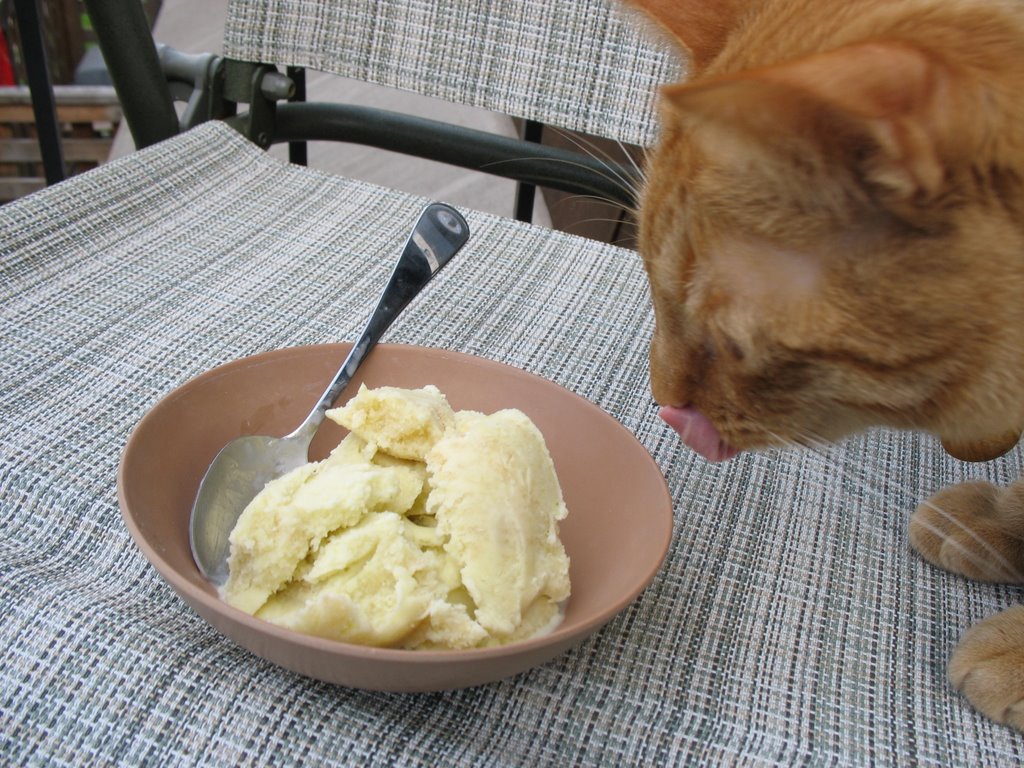
I don't know how he knows. If it's a slice of pizza or a sandwich, he doesn't bat an eye. But if I've got a bowl of ice cream or, as of today, a slice of grasshopper pie, Sabriel comes running. I'll hear the metal tag on his collar jangle oh-so slightly as he runs down the hall. If I'm sitting on the couch, he'll jump onto the back and investigate by leaning down over my shoulder to sniff what goodie I'm procuring. If I'm sitting at the computer, he'll hop into my lap and situate himself between me and the dish, his nose busily trying to figure out what I've brought him. Either way, he'll be purring loudly even before he reaches me.

What it is about these sweet treats that gets his motor running? He's a rather finicky cat. Apart from dry food and the occasional treat, the one food he'll bother eating is canned tuna. These days, he comes running when he hears a can being opened, reminding me of Hobbes in Calvin and Hobbes, and always manages to get completely underfoot. (Too bad when it's just garbanzo beans!) He generally only really likes green tea ice cream and chocolate anything: ice cream, pudding, cookies. He won't actually eat the pudding or the cookies, but he still comes to check it out. When it's ice cream, he'll lick a little bit of the melted remnants off a spoon before feeling satified and disappearing.

And now with this pie! (Which, by the way, has improved even more after sitting in the fridge for a couple days.) Maybe it was the chocolate crust, but he did get a tiny taste of green grasshoppery goodness off my fork. I guess that's cats for you, though: you never can quite figure them out.

Wednesday, March 14, 2007

Pi(e) Day

Despite being in the midst of writing the fourth chapter of a five-chapter thesis (the first draft of which I'm submitting on Saturday!), I took the time to honor Pi Day today. (For those of you not quite so geeky, or who don't have friends who are: Pi = 3.1416. Today's date = 3/14. Get it? Good.)

I'd already made fruit pies and savory pies, so it was time to try something new. I chose the delicious-sounding grasshopper pie, which I'd never had before — though I do love me a grasshopper drink, which is comprised of creme de menthe, creme de cacao, and cream. The pie is basically the same thing, with the addition of a crust made from pulverized mint Oreos. It's definitely not a pie for the kids, since the alcohol doesn't get cooked off, and, in fact, you can still taste it faintly behind the strong chocolate-peppermint flavors. Oh, and there's also gelatin in there, so it's not so good for strict vegetarians, but it made the texture very interesting: creamy, smooth, with a slight bounce reminiscent of Jello.

Recipe to come shortly, as well as the previously promised complete pie post, once I get this paper written.

Saturday, March 10, 2007

Am I allowed to say "ew"?

I'm all for adventure when it comes to eating. As a kid, I ate tripe, fish eyes, squid tentacles, marrow, and head cheese, without giving it much thought. I was one of few people I knew when I first started college, before it became trendy, who had eaten raw fish and actually enjoyed it. I've had frogs' legs, sea urchin, eel (what is it about creatures from the ocean that make most people squrim?), haggis, black pudding (not to be confused with the sort found in D&D), and dinuguan, which is pork stewed in its own blood. More recently, I tried sea cucumber for the first time.

But when I read this post, I wondered: How far is too far? Is there such a thing as being "too adventurous" — and by that I mean, when does it become less about eating and more about being able to say you've eaten something out of the ordinary? And then the real question: Would I eat it if someone placed a bowl of risotto topped with cockscomb and duck tongue? Maybe, just to say I had. But there are certain foods that I do truly find disgusting, like poultry heads and feet, so that dish, in particular, pretty much grosses me out.

What about you? Are there any foods you just won't eat? (Which is different from foods you can't, like ones which you are allergic to or don't eat as a matter of principle — yeah, I'm talking to you, vegetarians.)

Wednesday, February 28, 2007

Hiatus

Sorry about the lack of posts. I've been working on the draft of my Master's thesis, which is due in a couple weeks. I've been making time to cook, but not to write about it! So I leave you with this photo of a mountainous apple pie that I made a while back (the Anthopologist said, "It's huge! You have to take a photo"), and I promise I'll tell you all about the end of my pie-making challenge, which I officially wrapped up earlier this month.

Saturday, February 17, 2007

The cat who came to dinner

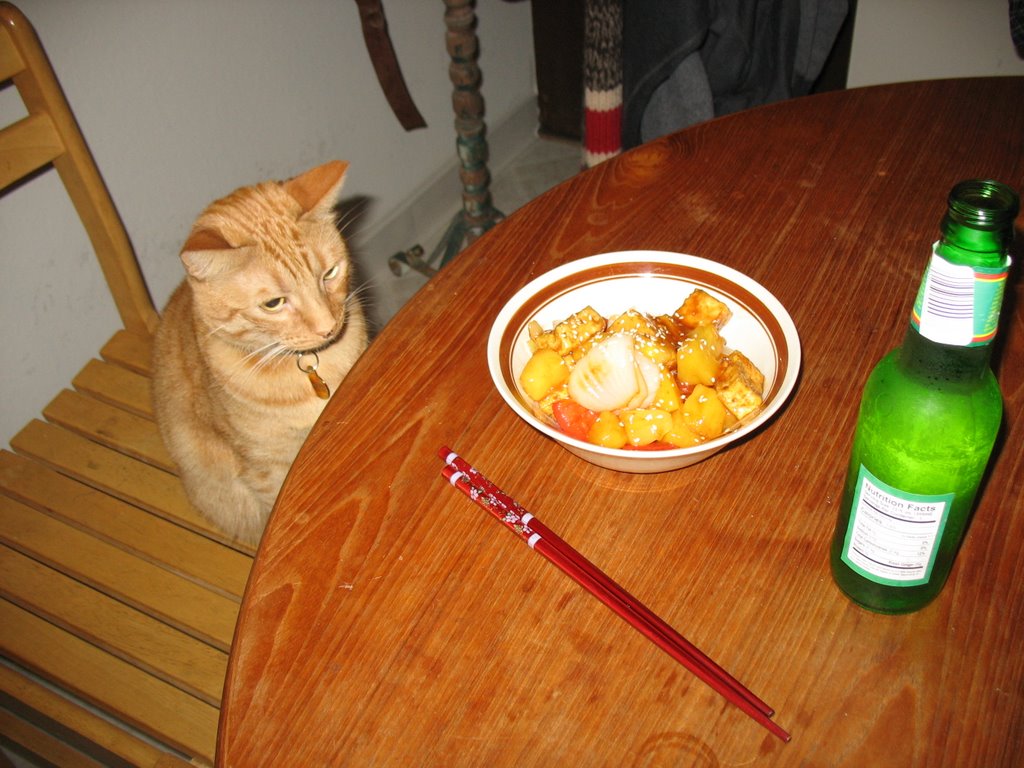
Sabriel likes to be where the people are. Which often means he comes to the kitchen table when the Anthropologist and I are sitting at it. While he also enjoys walking around on top of the table or lying on top of something we're trying to read, his favorite is to take our seat when one of us gets up. Here he inspects a bowl of sweet and sour tofu and wonders if chopsticks would make good cat toys. (They roll when batted, so they do!)

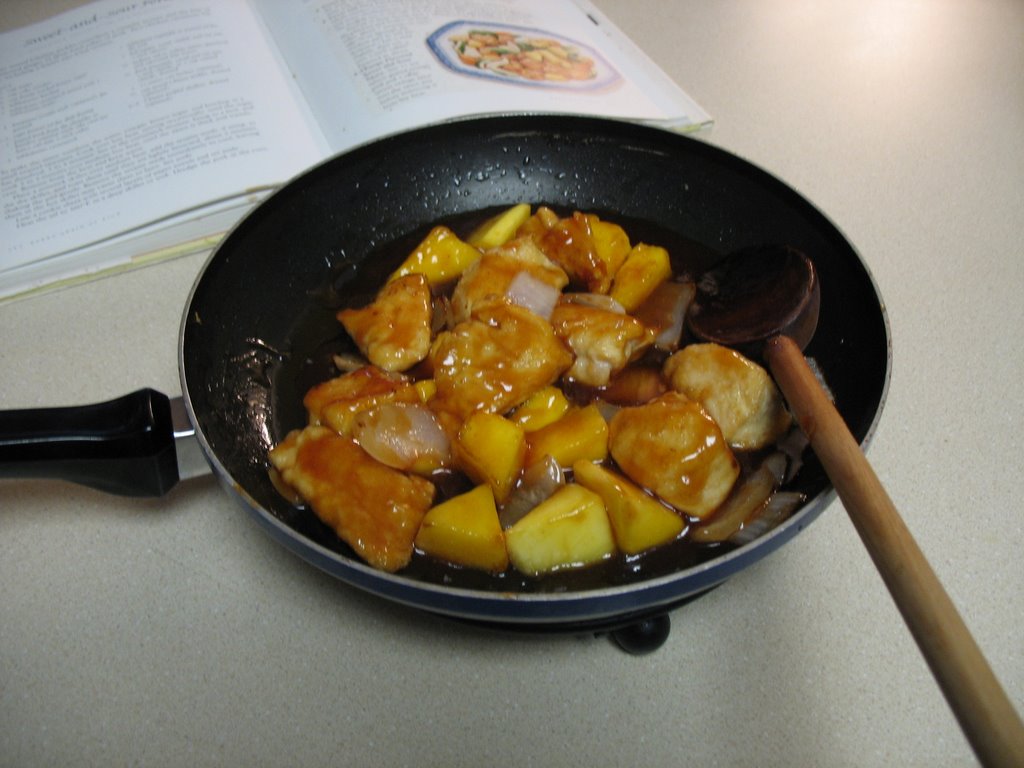
In honor of the start of the year of the boar tomorrow, I thought I'd mention my pride in being able to make a good sweet and sour. I got the recipe from a cookbook my mom gave me a few years ago, Every Grain of Rice (which, apparently, is already out of print and goes for upwards of $55 on Amazon!). I do love a good sweet and sour pork or chicken or even tofu, and I've even found myself craving it from time to time. This recipe does not call for the meat (or tofu) to be coated in a thick, heavy batter, which I really like, and it makes the best, all-purpose sweet and sour sauce I've ever tasted outside of a good Chinese restaurant. (I make it all the time as a dip to accompany my fried shrimp and shiitake wontons.)

Sweet and sour pork was one of the first Chinese recipes I'd ever tried to make — wonton soup and scrambled eggs with ketchup and green onions being foods I'd made previous to that. It made me realize that Chinese cooking is not all that difficult and led me to other yummy, "homestyle" dishes such as long-life noodle soup, tomato beef chow mein, and pan-fried prawns in ketchup sauce.

I realize that, for a lot of people, it's much easier just to order take-out from a nearby Chinese restaurant — but, like with all home-cooking, I like being able to control what ingredients go into my meals, and I like having the satisfaction in knowing I can make something that most people wouldn't even bother to cook.

One of the families I work for is spending the day today with the grandparents to celebrate Chinese lunar new year, and then I'm watching the kids while the parents celebrate Tet, the Vietnamese new year, with Andrea Nguyen, who is cooking up a delicious-sounding meal. (What I wouldn't give to be there, too!) Perhaps tomorrow I'll go with the Anthropolgist to the Golden Buddha, a slightly fancier Chinese restaurant that I haven't been to a long time but which is absolutely delicious. Or I'll make my favorite sweet and sour, trying the sauce over fried fish this time for a little twist.


Sweet-and-Sour Pork
(adapted from Every Grain of Rice: A Taste of Our Chinese Childhood in America by Ellen Blonder and Annabel Low)

1/4 cup water
1/4 cider vinegar (although I often use red wine vinegar)
1/2 cup firmly packed brown sugar
2 tablespoons ketchup
1 tablespoon cornstarch mixed with 3 tablespoons water

oil for pan frying (peanut oil is recommended, but I use canola)
1 pound pork from the shoulder or boneless country-style ribs (or chicken breast or tofu — see Note), cut into 1-inch cubes
2 tablespoons cornstarch
1 bell pepper, cored, seeded, and cut into 1-inch squares
1/2 medium yellow onion, quartered and separated into layers
1/2 fresh pineapple, cored and cut into 1-inch chunks, or 1 cup canned chunks (or 1 fresh mango, peeled and cubed)

To make the sauce, combine the first four ingredients (through ketchup) in a small non-aluminum pan. Cook over low heat, stirring occasionally, until the sugar dissolves, 3 to 4 minutes. Stir in the cornstarch mixture, bring to a boil, and cook over medium-low heat until the sauce is thick. Turn down heat to very low and keep warm.

Heat about an inch of oil in a deep skillet (I use cast iron). Dredge the pork (or whatever) in the cornstarch, then divide into three batches. Put the pieces from the first batch into the oil (if you try to put too many into the pan at once, the meat will be crowded and won't become crispy). Cook 4 to 5 minutes, until browned, turning to brown evenly. Cut through one piece to test for doneness; it should be white and opaque. Remove the meat and let drain on a cookie sheet lined wth paper towels. Repeat with the next two batches.

In another pan, heat a tablespoon of oil. Add the pepper and the onion and stir-fry until the onion is wilted and transparent, 4 to 5 minutes. Add the meat and pineapple (or mango) and heat through for a couple minutes. Add the sauce and cook 1 minute longer.

Note: If you use tofu, be sure to drain it really well by pressing it between two plates and weighting it down, like with a heavy book or a large can, for several minutes. Water-logged tofu won't fry well.

Tuesday, February 13, 2007

Let's check this one off the list

Everyone always talks about Chez Panisse. The name keeps popping up in the newspapers and in the food blogs I read. I keep hearing about how good the food is and what an impact Alice Waters has had on food and the way we eat.

That settles it. I simply must go.

L-Train, one of my best friends, and I have birthdays in June that are a day apart. I think this year we will have to go out on the town, pretend we are not paying off enormous student loans for one night, and splurge on some delicious food. The restaurant offers one fixed-price menu every night — which is kind of a cool idea and means you show up and eat what's offered to you. It does worry me a little because my friend is not a red meat-eater, and it's sort of a toss-up as to whether the main course will involve meat, chicken, or fish. And if you think you can just look at their menu during that week and show up on the night of a particularly attractive menu, you are sadly mistaken. Dinner is by reservation only, with reservations accepted beginning a month to the day you wish to go.

Am I going to let that stop me? I will get those reservations! I'll convince L-Train to play the food lottery and hope for the best! Because, dammit, I'm going to Chez Panisse.

Sunday, February 11, 2007

Making soup in the dark

There are certain types of food that I feel especially proficient at: Italian (pasta, pizza), Mexican (enchiladas, tacos, huevos rancheros), and, of course, American (baked mac and cheese, roast chicken, hamburgers). I can even do a little bit of Americanized Chinese (sweet and sour pork, oyster beef and brocolli). But there are some areas in the food world where I feel my skills fall short — or, at least, where I have little experience.

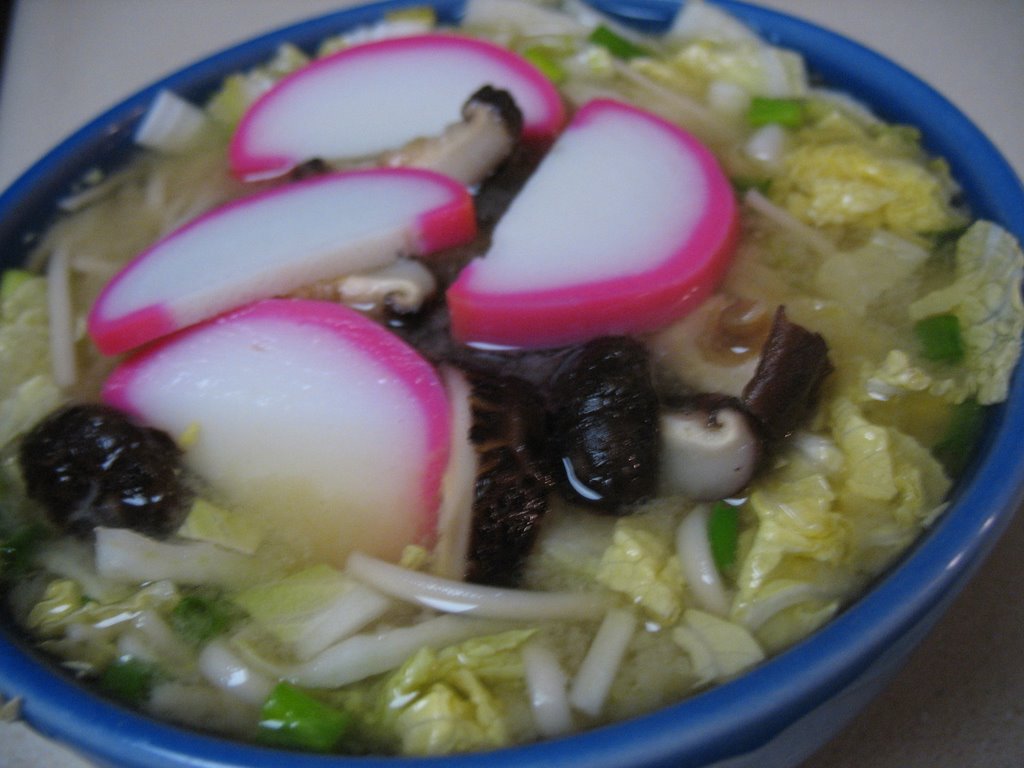
Using Seductions of Rice as a guide, I recently attempted to make a bowl of udon soup. Actually, all I had to work with was a recipe for dashi, a broth made from kombu and bonito flakes. And I didn't have any bonito, having no Japanese markets nearby (which is one of the things I greatly dislike about living in Santa Cruz — no Asian grocery stores!). So I made a variation of dashi, using kombu and dried shiitake mushrooms.

My local natural foods place sells kombu in bulk, and this was the first time I'd used it. Unlike mild, sweet nori, kombu smells just like the seaweed that washes up on the beach and lies around in the sand: kind of stinky. I didn't let that stop me, though, and even later used the briefly-boiled kombu to make a black kombu relish, which I have yet to try.

Once the dashi was ready, I realized I had no idea what to do next to make my dream of udon a reality. I have cookbooks for all sorts of foods — West African, Filipino, Vietnamese, Chinese, and, of course, the usual tomes of "everything" the author assumes you'd want to cook (How to Cook Everything, for example) — and while I've learned a lot from the Food Network, the shows typically showcase foods that are European or Euro-American. I'm pretty much in the dark when it comes to Japanese cooking. So I did what any hungry cook worth her salt would do: I made up the recipe on the fly.

I mixed a little miso paste into the dashi. Then I chopped some napa cabbage and green onions and put them into a bowl over some cooked udon noodles. I poured the hot miso over everything, then added the mushrooms that had been used to make the broth as well as some sliced fish cake. The result was, well, decent. Not as satisfying as going to the Pink Godzilla and ordering a bowl of udon with tempura, but it tasted okay and was filling.

It's high time I got a book on Japanese cooking, considering it's pretty much my favorite kind of food. I know it's probably easier to just go to a restaurant, but there's something really gratifying in being able to recreate the food at home.

Monday, February 05, 2007

Puppy Bowl!

The Super Bowl? What's that? Yesterday was all about Puppy Bowl. I'd been looking forward to it since I saw the commercials on Animal Planet around Christmas. As I've said elsewhere, how can you not love puppies running around a miniature football field, tumbling about, and just looking really cute? I had a whole afternoon planned, complete with snacks to accompany hours and hours of puppies.

I made Glorified Frijoles, using a recipe I got from The San Francisco Chronicle a few years back, and a cheese dip made with Velveeta. Yes, I know. Processed cheese food is just about the exact opposite of whole food. But I have a slight obsession with gooey, neon orange, fake cheese, and I'd never cooked with a brick of Velveeta before so I was kind of excited about it. These were served with soy and flax seed tortilla chips, which I thought would make the whole thing slightly healthier.

I end up making a ton, which I thought I would have to eat all by mself, until the Anthropologist returned from the Seabright Brewery, having not found a place to sit, with a friend in tow. So it was a good thing I'd made so much!


Glorified Frijoles
(adapted from a recipe by
Jacqueline Higuera McMahan)

1/4 c diced onion
1 clove garlic, minced
1 15-oz can refried black beans with jalepenos
4 oz cream cheese, cut into small pieces
Chile powder, to taste
1/2 c shredded sharp cheddar cheese
(The original recipe also calls for chopped fresh tomato, which I omitted because they are out of season, as evidenced by the sad, yellowish specimens at the grocery store. But go ahead and add some if you like.)

In a small saucepan, saute the onion in olive oil until fragrant. Add garlic and cook for another minute. Add beans and heat through, then stir in cream cheese until combined. Add chile powder and cheese, and cook until "volcanic."


"Posh" Velveeta dip

4 oz Velveeta cheese, cut up into small pieces
1/4 c jarred salsa
1/4 c sour cream
green onion, sliced
cilantro, chopped

Put cheese food, salsa, and sour cream into a microwave safe bowl, and microwave for about 3 minutes. When melted, stir in green onion and cilantro, mixing to a smooth consistency.

Monday, January 29, 2007

Food fit for a quest

Sometimes I like to do extremely dorky things on the weekends, like play Dungeons and Dragons with the Anthropologist, a couple of people from the forensic anthropology department, and their partners. But this isn't the D&D you knew in junior high, with you and your friends sitting in the basement with a bag of chips and a box of soda. Three of the players (myself included) love to cook, so when we do potlucks, we are eating well.

For this game, I made enchiladas suizas and a banana tarte tatin. I didn't take any photos at all because I was in a rush to get it all done before we had to leave, but I can tell you, they looked and tasted delicious. The enchiladas had flour tortillas wrapped around sliced Quorn cutlets, a tomatillo sauce, and Swiss cheese, topped with a white sauce and more cheese. The tarte tatin was like a puff pastry filled with bananas Foster.

I like playing with these guys because I get to talk food with them. Cris, who made chicken marsala with sage, mushrooms, and red onions, recently mentioned wanting to get a pasta maker for her KitchenAid. When I expressed interest (and jealousy!), she said I'd have to come over and make pasta with her. That's something I'm looking forward to — because I've always wanted to make pasta from scratch. She also recognized that my enchiladas were based on a recipe she'd also used from Cooking Light. I love bonding over food!


Enchiladas suizas
serves 8

1 lb tomatillos (about 10), husked
2 jalapeño chiles
1/4 c loosely packed cilantro
2 cloves garlic
1/2 yellow onion, chopped
1/2 c sour cream (light, if you want), divided
1-1/2 c milk (whole or 2%)
1-1/2 tbsp flour
4 Quorn cutlets (one box)
8 flour tortillas
8 oz Swiss cheese, shredded and divided

Preheat oven to 350° F.

Place the tomatillos and chiles in a saucepan, and cover with water. Bring to a boil, and cook for 8 minutes. Drain, reserving 1/2 cup water. In a food processor, puree tomatillos and chiles with cilantro and garlic, adding water to thin if necessary. In the same saucepan, sautee onions until fragrant, then add tomatillo puree. Simmer for ten minutes, until reduced to about 1 cup. Remove from heat, and stir in 1/4 cup sour cream.

Put Quorn into a shallow dish, and microwave according to package instructions. When cool enough to handle, slice into thin strips.

In another saucepan, combine milk and flour over medium heat, stirring constantly with a whisk. Cook until thickened. Remove from heat, and whisk in remaining 1/4 cup sour cream.

Heat tortillas (in the microwave, in a dry pan, whatever). Spread 1/3 cup of tomatillo sauce on the bottom of a 9" x 13" pan. In each tortilla, place a few strips of Quorn, about two tablespoons of cheese, and a generous spoonful of tomatillo sauce. Roll up, and put into prepared pan. Top enchiladas with remaining tomatillo sauce (if any), the white sauce, and about 1 cup cheese.

Bake, uncovered, for 30 minutes.


Banana tarte tatin
(from Martha Stewart Living)
serves 8

1 sheet frozen puff pastry, defrosted
6 tbsp unsalted butter
3/4 c light brown sugar
1/2 tsp cinnamon
1/8 tsp salt
5 ripe bananas, peeled and sliced lengthwise
1 tsp vanilla extract
2 tsbp dark rum
Creme fraîche, for serving

Preheat oven to 425° F.

On a lightly floured surface, trim puff pastry to a 12" circle. Place on a baking sheet lined with parchment paper and refrigerate for 15 minutes. Cut three 1/2-inch slits in the middle, and set aside at room temperature.

In an oven-proof skillet, melt butter over medium heat. Stir in brown sugar, cinnamon, and salt, and cook until amber, about 3 minutes. Place bananas in skillet, all lined up in the same direction, slightly overlapping (but don't worry if it's not perfect). Cook, without stirring, for 5 minutes. Sprinkle vanilla and rum over the top, and cook another 3 minutes. Place the puff pastry on top, trimming with kitchen scissors if neccesary.

Bake for 25 minutes.

Let cool slightly, then place a serving plate on top of the pan. Invert the entire thing, then lift the pan off the plate. If the tarte sticks, turn the pan back over and run a small spatula underneath the bananas, and try again.

Serve with creme fraîche, whipped or not.


(I would just like to note here that I just typed these two recipes from memory, which I think goes to show how easy they are to make!)

Tuesday, January 23, 2007

Breakfast of champions

On the mornings when I don't have to rush off to work (which wasn't today!), I'm trying to eat more well-rounded breakfasts that won't leave me starving after an hour or two. After exhausting my possibilities with the usual breakfast fare of hot cereal, smoothies, and scrambled eggs, I decided to change things up and eat breakfast the way my Filipino relatives do.

I should mention here that I'm in the proces of giving up pork. After petting the pigs at the county fair in September and being reminded (yet again) by the Anthropologist of how smart they are, I decided that I really have to stop eating them. (As for beef and poultry, I still eat them because I think those animals are pretty dumb, and therefore okay to consume.) I still have sausages in my freezer, though, so I'm slowly eating those up. And occasionally, I order something at a restaurant that has bacon in it because I forget I'm not eating pig anymore — and man, it's hard to give up bacon.

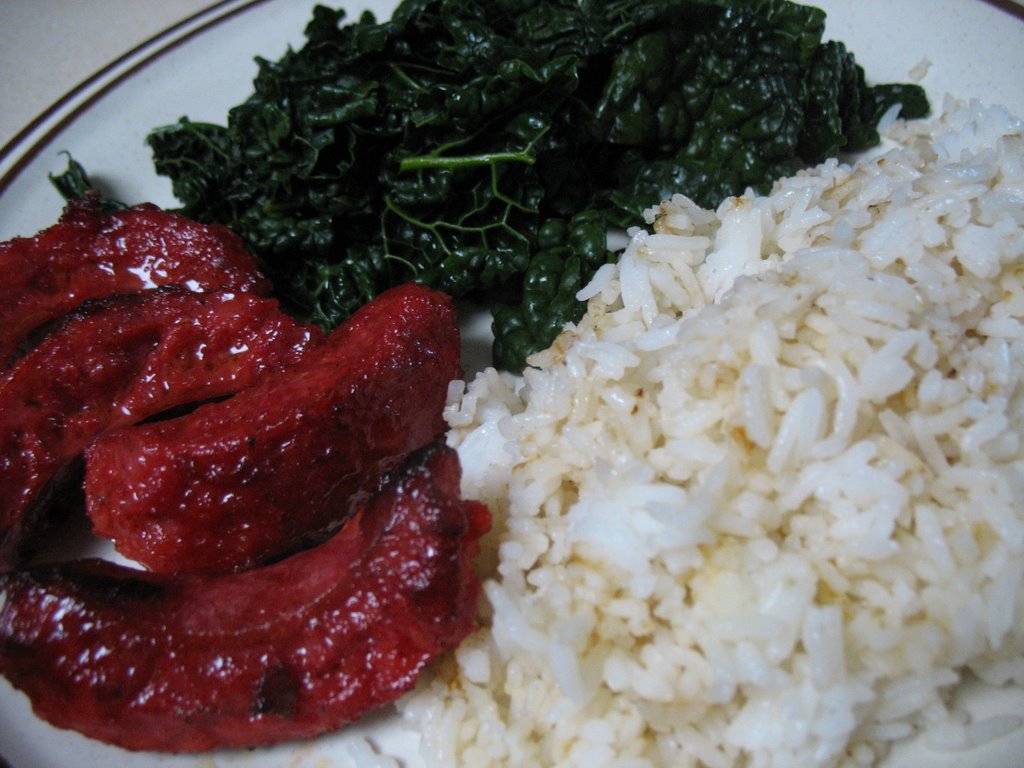
A little while ago, my mom gave me some longanisa, or sweet Filipino sausage. For breakfast over the weekend, I sliced two of those interestingly red sausages in half lengthwise and cooked them up in a cast iron skillet. After they were browned and curled, I removed the sausages and drained off some of the fat, then threw in some leftover rice — not to fry it, but just to reheat it and soak up the grease. Typically, any sort of meat and rice my mom serves is accompanied by tomatoes, but since it's winter, I decided to make some kale instead, seasoning it with soy sauce and sugar. Not Filipino in the least (actually, making greens that way is Japanese-inspired), but still good. The meal was delicious and definitely filling.

I like eating a big, mid-morning meal, especially since early breakfasts are too early and I almost never have time for lunch. I'll have to find an appropriate replacement for the sausages once I run out of them, though.